
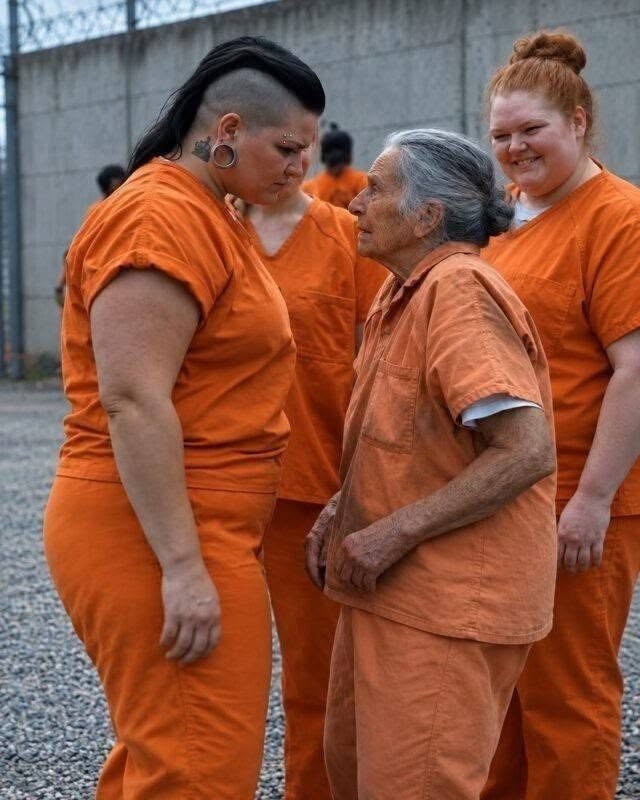
The prison yard was usually filled with noise, arguments, and tension. But one afternoon, something unusual happened that made everyone stop and watch.
An elderly woman, whose silver hair and fragile appearance made her stand out among the other inmates, found herself standing face-to-face with a much younger prisoner.
The younger woman was known for her intimidating appearance and difficult personality. Other inmates often avoided confronting her because they didn’t want trouble.
But the elderly woman didn’t step back.
She looked directly into the younger woman’s eyes, standing calmly despite the obvious difference in their size and strength.
At first, the other prisoners assumed an argument was about to begin. Some moved closer, while others watched from a distance, waiting to see what would happen.
Nobody expected what came next.
An Unusual Meeting Behind Prison Walls
Life inside a correctional facility can be challenging. Inmates come from different backgrounds, have different personalities, and often carry difficult personal experiences.
For an older woman, adjusting to prison life can be particularly demanding.
The daily routine, limited privacy, separation from loved ones, and emotional pressure can make each day difficult.
Younger inmates may struggle with their own challenges, including anger, frustration, and the consequences of decisions made before entering prison.
When people from such different generations share the same environment, misunderstandings can easily occur.
However, sometimes an unexpected conversation can change the atmosphere completely.
Why the Younger Woman Was So Surprised
The younger prisoner had apparently expected the elderly woman to avoid her.
Instead, the older woman remained calm and spoke to her without raising her voice.
She didn’t try to intimidate her or compete with her physically.
She simply wanted to make a point.
The younger woman initially appeared confused. She was accustomed to people reacting to her appearance, but this woman seemed completely uninterested in being frightened.
For a moment, the surrounding inmates fell silent.
The elderly woman’s calm attitude was more powerful than anyone expected.
The Hidden Struggles of Older Women in Prison
Behind the prison walls, older inmates face challenges that are often overlooked.
As people age, they may develop health conditions, experience reduced mobility, or require regular medical attention.
Everyday activities can become more difficult, especially in facilities that were not originally designed to accommodate older adults.
Common challenges include:
-
Limited access to age-appropriate healthcare.
-
Difficulty climbing stairs or walking long distances.
-
Separation from children and grandchildren.
-
Feelings of loneliness and isolation.
-
Anxiety about the future.
-
Difficulty adapting to prison routines.
Older women may also experience emotional difficulties when they lose contact with family members.
For some, the hardest part of incarceration is not the physical environment but the feeling that the world outside continues moving without them.
Continued on the next page →
A Conversation That Changed the Atmosphere
According to the fictional story, the elderly woman eventually explained why she had approached the younger prisoner.
She told her that everyone in the facility had a story, and that appearances rarely revealed what someone had experienced.
The younger woman listened without interrupting.
For the first time that afternoon, her expression softened.
The older woman reminded her that anger could make difficult situations even worse, particularly when people were already living under enormous pressure.
She also explained that respect did not require someone to be physically strong or intimidating.
Sometimes, the strongest person in a room was simply the one who knew how to remain calm.
The conversation attracted the attention of several other inmates.
What had initially looked like a confrontation gradually became an unexpected moment of understanding.
Why Relationships Matter in Prison
Maintaining positive social relationships can be important for emotional well-being during incarceration.
Prisoners who have access to constructive social support, educational opportunities, and rehabilitation programs may find it easier to develop healthier ways of responding to conflict.
Positive interactions can also help reduce feelings of isolation.
For older inmates, friendships with younger prisoners may offer opportunities to exchange experiences and perspectives.
Younger inmates, meanwhile, may benefit from hearing the experiences of people who have lived through different generations and difficult circumstances.
Of course, not every interaction is positive, and correctional facilities must maintain appropriate safety measures.
But respectful communication can make a meaningful difference in shared living environments.
The Importance of Rehabilitation and Second Chances
Prison is intended not only to restrict freedom as part of a criminal sentence but also, in many correctional systems, to provide opportunities for rehabilitation.
Educational programs, vocational training, counseling, and structured activities can help inmates prepare for life after release.
Older prisoners may need specialized support, while younger inmates may benefit from programs that address emotional regulation, decision-making, and conflict resolution.
Every person has a different history, and rehabilitation should take individual circumstances into account.
What This Story Reminds Us About Human Nature
The image of two women from completely different generations standing face-to-face offers an interesting reminder.
Strength does not always come from physical appearance.
Age does not necessarily mean weakness, and a difficult personality does not mean someone is incapable of change.
Sometimes, a calm conversation can accomplish more than an argument.
The elderly woman’s courage in this fictional story comes not from fighting the younger prisoner but from refusing to respond to intimidation with more intimidation.
Final Thoughts
Life behind prison walls is complicated, and every inmate has a different story.
For older women, incarceration can bring additional physical and emotional challenges. For younger prisoners, it can be an opportunity to reflect on past decisions and work toward a different future.
The unexpected encounter described here reminds us that respect, patience, and understanding can exist even in difficult environments.
A person’s past does not tell us everything about who they can become.
And sometimes, the most memorable moments happen when two people choose to listen rather than fight.
